Terms of Service | Privacy Policy | Copyright © 2026 Diamond Willow Advisory All Rights Reserved. | Website Design by Woods


Canada’s trade dependence on the United States is once again under the microscope. With new U.S. tariffs reshaping demand, exports in autos, energy, and forestry have fallen sharply, trimming Canada’s trade surplus with the U.S. by nearly 17% this year. Yet, even as traditional sectors weaken, momentum is building elsewhere: exports to the U.K. and China are climbing rapidly, led by surging demand for metals and minerals. These trends mark a structural turning point — one where diversification is not just an option, but an imperative for Canada’s long-term growth and capital resilience.
Key Takeaways this Month:
.png)
.png)
Historically, the U.S. has accounted for 75%+ of total Canadian exports – however, this has shifted downwards to 73% since new tariff policies were introduced.
.png)
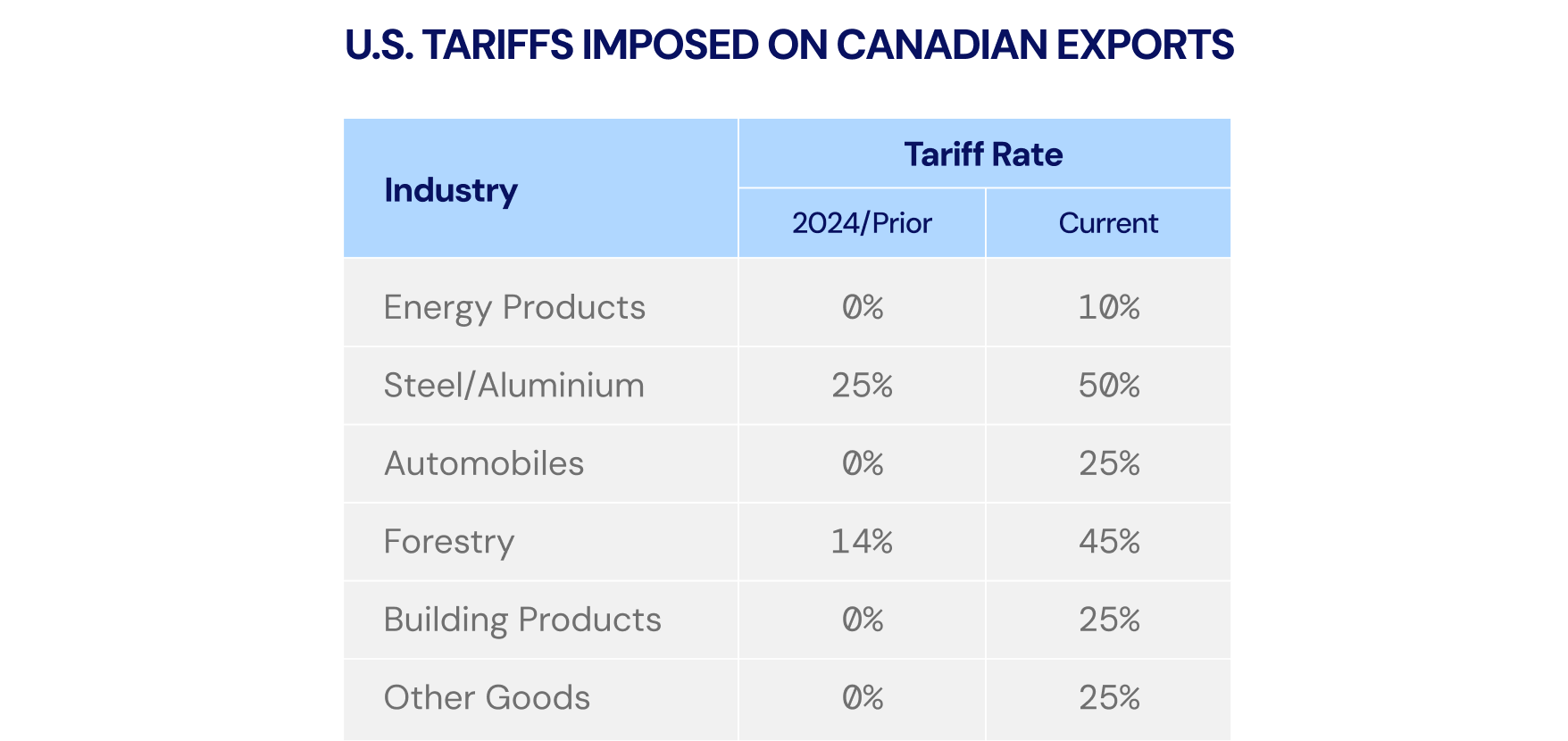
Canadian exports to the U.S. in autos, energy, basic materials, and forestry fell $17.7B YoY, while metals and minerals surged $15.3B, highlighting a shift in sectoral export demand from the U.S.
The U.S. Knows Exactly What They Want: Canadian exports to the U.S. are showing a notable sectoral shift. Autos, energy, basic materials, and forestry fell a combined $17.7B YoY through August, with tariffs driving declines in autos ($3.9B), energy ($5.5B), basic materials ($5.1B), and forestry ($3.1B). Meanwhile, metals and non-metallic minerals surged $13.2B, a 10.8% YoY increase, underscoring rising U.S. demand in these sectors. While largely anticipated, these trends signal a structural change in Canadian export patterns toward metals and minerals.
.png)
Canada’s trade balance with the U.S. has narrowed to $56.4B (Jan – Aug 2025) versus $67.7B (Jan – Aug 2024).
Canada’s Trade Balance With the U.S. Narrowing: Historically, Canada has maintained an asymmetric trade relationship with the U.S., running consistent trade surpluses. Weakening exports in the energy, auto, forestry and basic material sectors have caused this trade balance to narrow in 2025, which has been partially offset by increased exports in metals and minerals. The trade balance between Canada and the U.S. currently stands at $56.4B (Jan – Aug 2025), which is a decline of 16.7% versus the same period in the prior year ($67.7B).
.png)
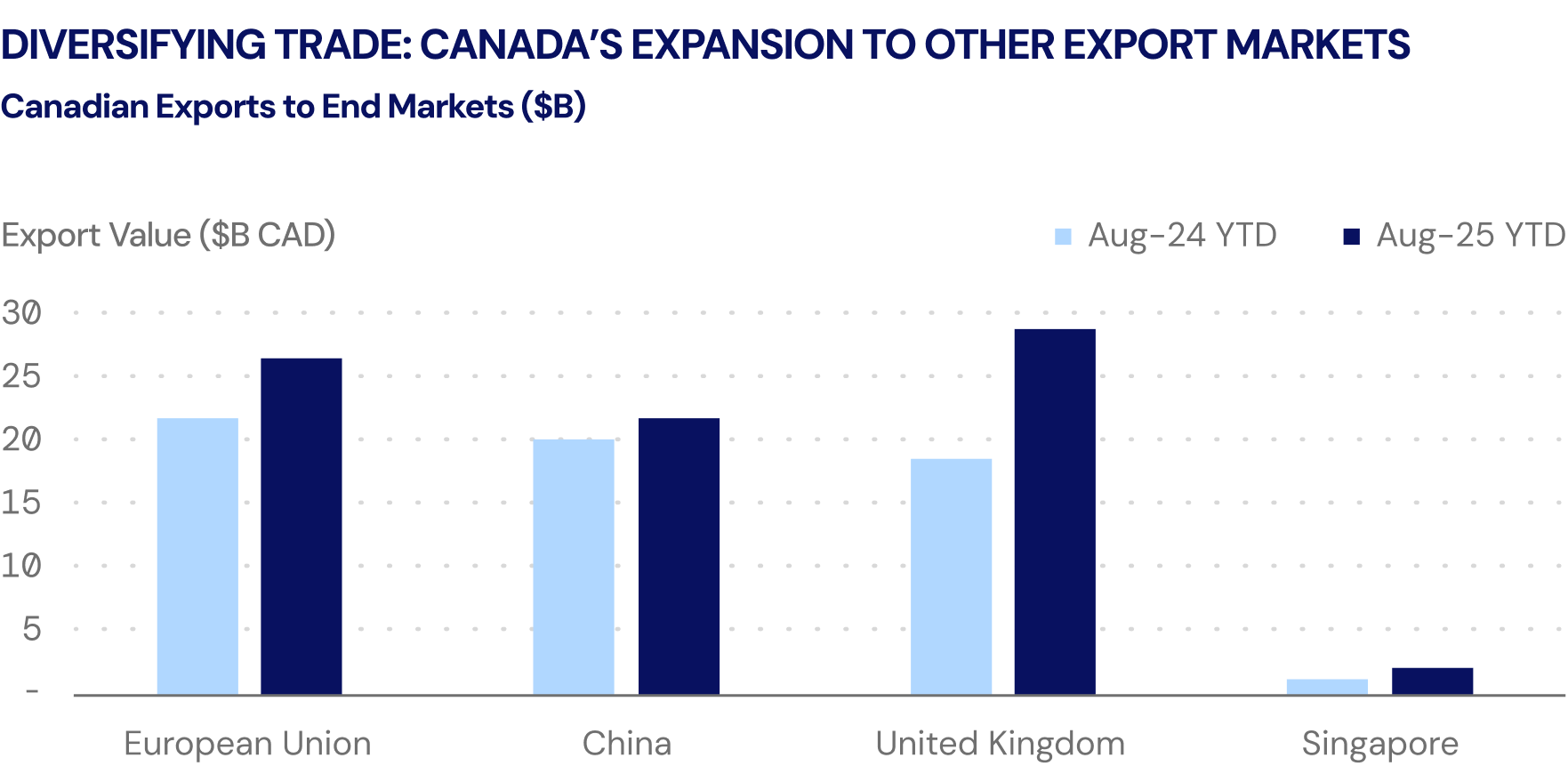
Exports to the U.K., E.U., China, and Singapore rose by a combined $17.7B through August 2025, partially offsetting the $13.0B drop in U.S. export value.
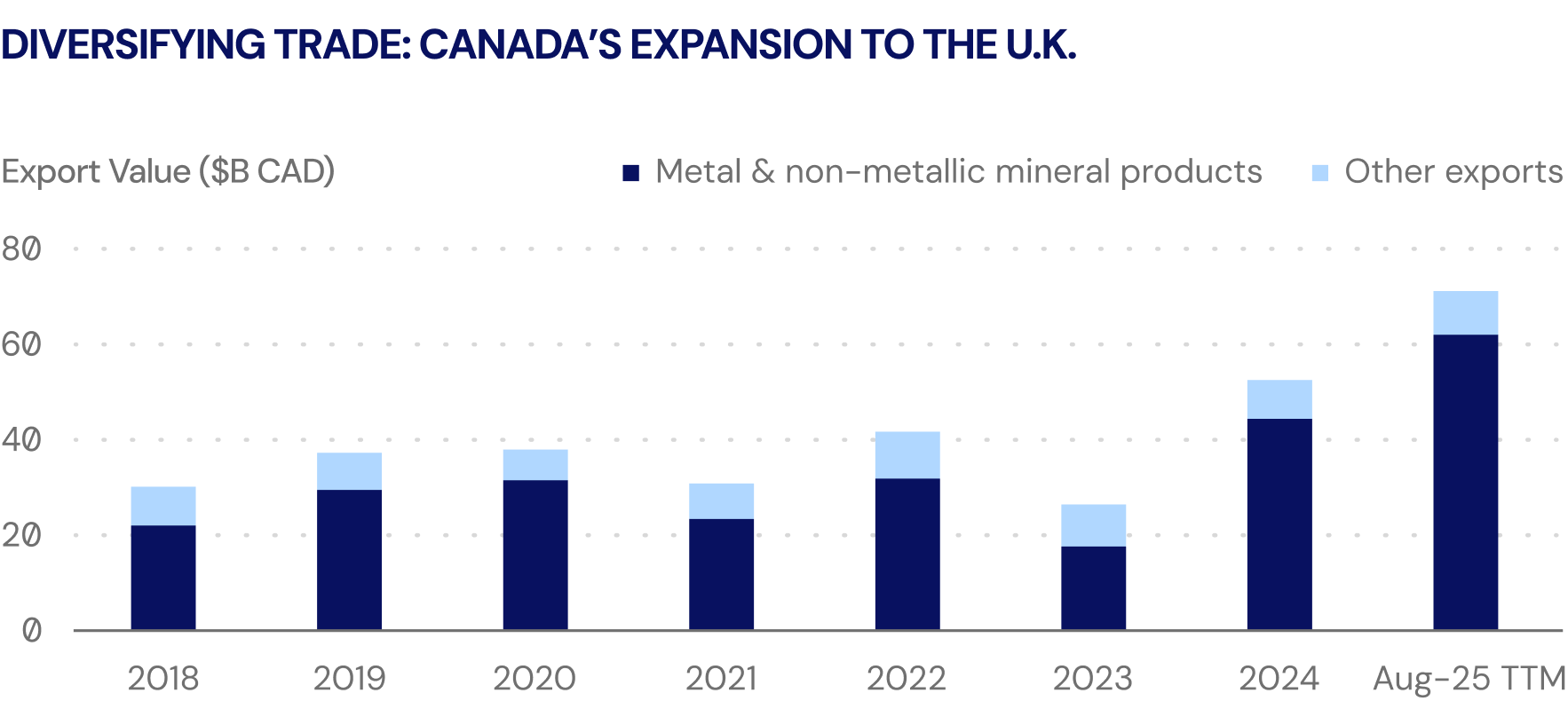
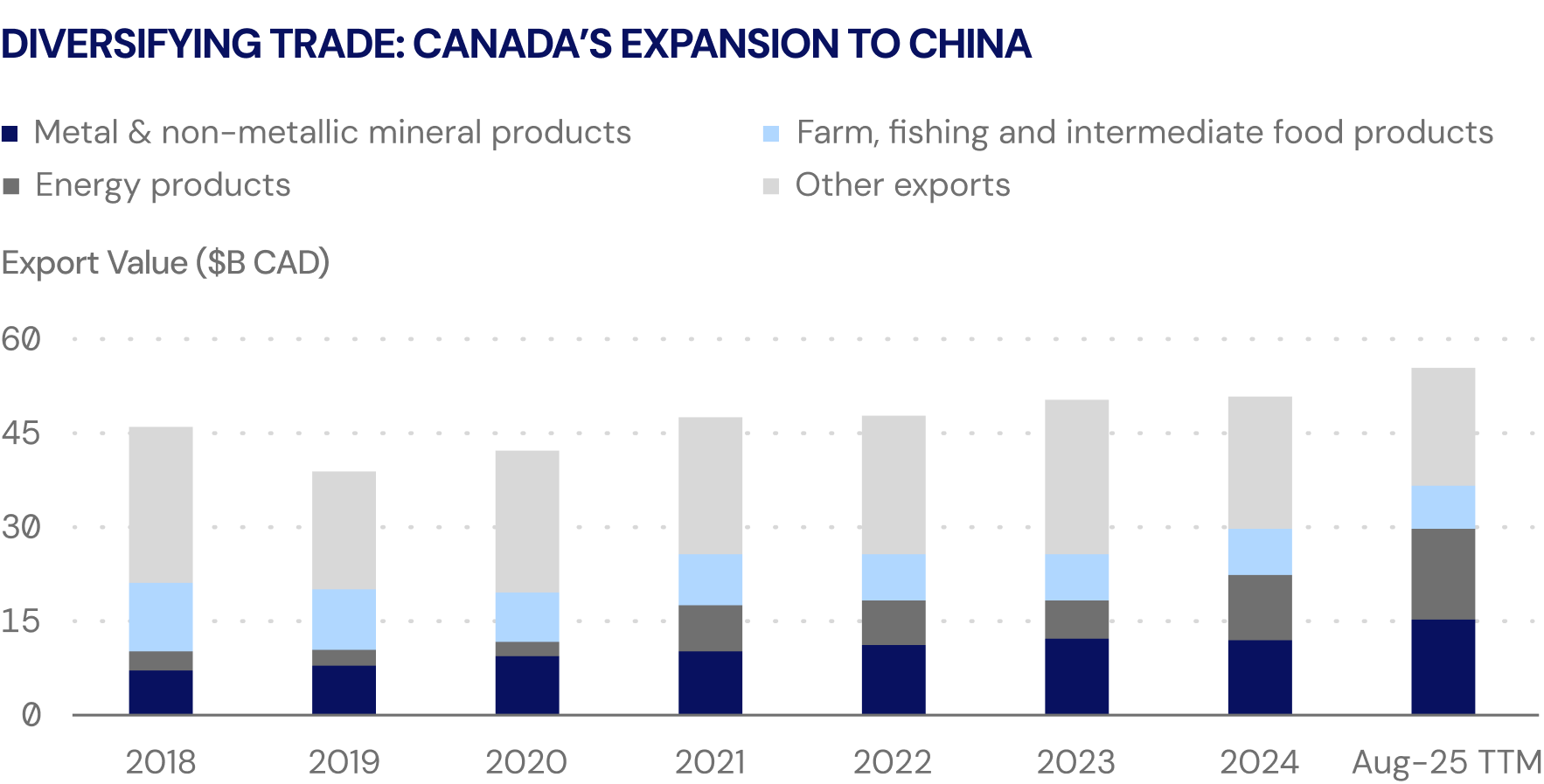
Most of Canada’s export growth in new markets was driven by increased demand for metal and non-metallic mineral products in the U.K. ($60.6B) and China ($12.5B).
Other Exports Markets are Softening the Blow: Although U.S. export value has declined, Canada is finding momentum in other markets — notably the U.K., where exports are up 34.7% YoY, and China, up 9.3% as of August 2025. Much of this growth stems from surging demand for metals and non-metallic minerals, with exports in the category rising to $236B (from $220B in 2024). The U.K. and China now account for 68% of Canada’s total metal exports, up from 51% a year earlier — underscoring the need for Canada to keep broadening its export base beyond the U.S.

Canada has ample food, energy, and base materials ready for export and now is the time to make deals with those countries who can provide the goods and capital Canada requires in return.
Energy: The LNG and Crude Catalyst
Food: Feeding a Growing World
Shelter: Building the World’s Foundation
Sources: Statistics Canada, Department of Finance Canada, The Observatory of Economic Complexity (OEC), The World Bank, USDA, World’s Top Exports, Diamond Willow Advisory.